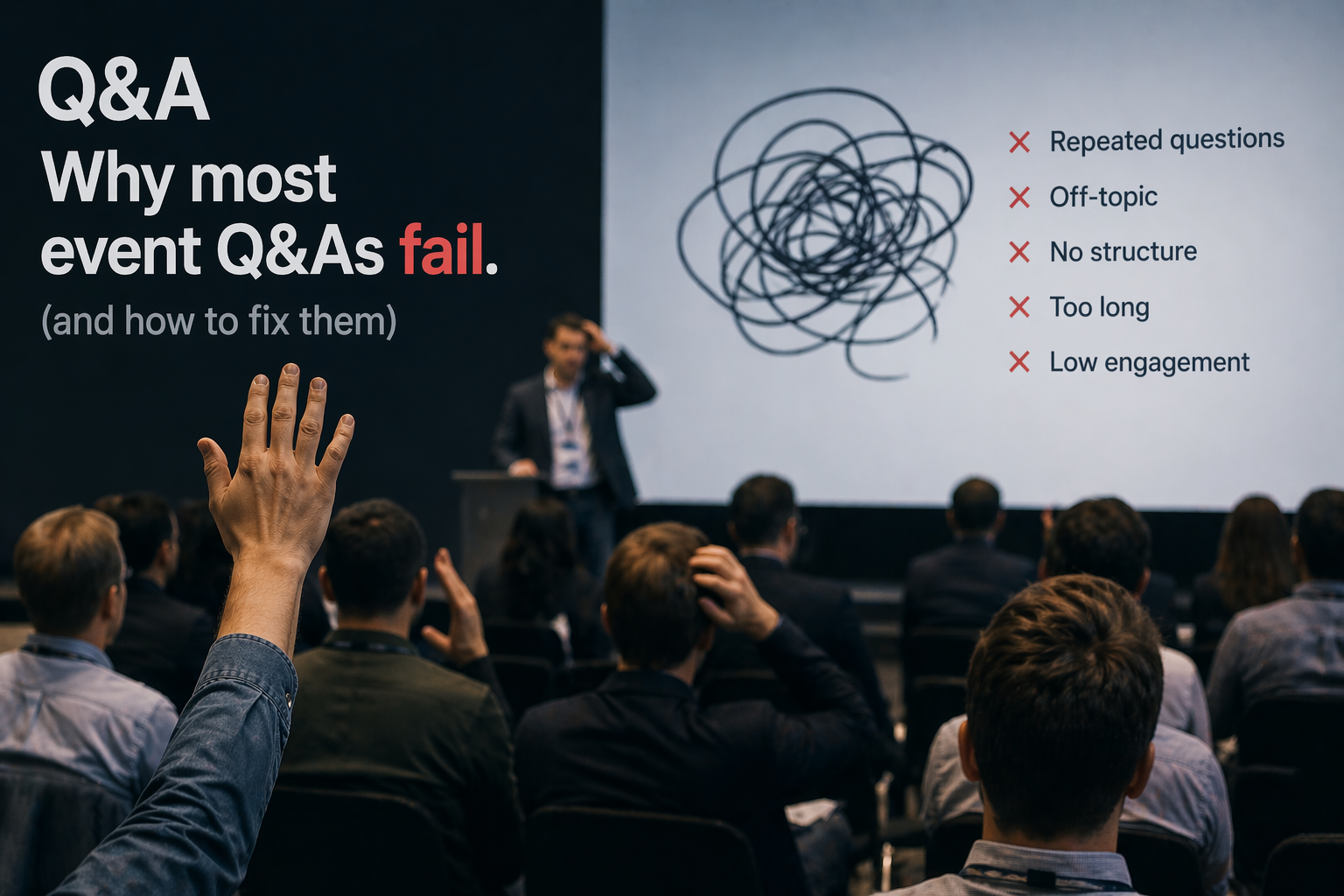
Why most event Q&As fail (and how to fix them)
Most Q&A sessions fail.
Not completely.
But enough to feel like wasted potential.
You get:
- A few good questions
- A lot of repetition
- Some irrelevant tangents
- And a vague sense that it could have been better
This isn’t a people problem.
It’s a design problem.
The root issue: Q&A is treated as an afterthought
In most events, Q&A is:
- Added at the end
- Poorly structured
- Barely moderated
It’s seen as a “nice to have”.
So it gets whatever time and system is left.
The result is predictable: low signal, low impact.
Failure #1: Open mic = random outcomes
The default format is still the same:
A microphone.
A line.
Whoever gets there first speaks.
This creates three problems:
- Selection bias: only the most confident (or fastest) participate
- Low relevance: questions are optimized for the individual, not the room
- No filtering: everything goes through, good or bad
You don’t get the best questions.
You get the most available ones.
Failure #2: No aggregation of demand
In a room of 200 people, many are thinking the same thing.
But without a system:
- The same question gets asked multiple times
- Or worse, only one version gets through
- And you don’t know how many people care about it
There’s no way to measure interest.
So you guess.
Failure #3: Answering too early
The first question appears. The speaker answers it.
Seems natural.
But it locks the session into a random direction.
Instead of identifying patterns, you react to sequence.
The session becomes fragmented:
- Topic A
- Topic C
- Topic B
- Back to A
No structure. No narrative.
Failure #4: Weak or nonexistent moderation
Most Q&A sessions are barely moderated.
At best, someone holds the mic.
At worst, no one filters anything.
This leads to:
- Off-topic questions
- Long-winded setups
- Poorly phrased submissions
Good moderation is invisible.
But its absence is obvious.
Failure #5: Optimizing for fairness instead of value
There’s an implicit rule in many Q&As:
“Everyone deserves a turn.”
Sounds reasonable.
But it breaks the session.
Because:
- Not all questions are equally valuable
- Not all questions benefit the audience
- Not all questions should be answered live
A good Q&A is not democratic.
It’s curated.
What good Q&A looks like
When it works, the difference is clear:
- Questions are sharp and relevant
- Topics flow logically
- The audience stays engaged
- Answers feel useful beyond the individual
It feels less like a queue.
More like a conversation.
How to fix it
1. Replace the mic with a system
Use a structured way to collect questions:
- Everyone can submit
- Nothing goes directly to the stage
- Inputs are reviewable
This removes randomness.
2. Let the audience rank what matters
Add upvotes.
This does three things:
- Surfaces the most relevant questions
- Collapses duplicates
- Gives you real demand signals
Now you know what the room actually cares about.
3. Wait before answering
Don’t start immediately.
Let questions accumulate for a few minutes.
Look for:
- Repeated themes
- Clusters of interest
- Patterns in wording
Then answer at the level of the pattern, not the individual question.
4. Moderate actively
Treat moderation as editing:
- Merge similar questions
- Rewrite unclear ones
- Remove off-topic noise
The goal is clarity, not volume.
5. Structure the session in real time
Group questions into themes:
- “Let’s start with strategy…”
- “Now implementation…”
- “A few questions on hiring…”
This creates coherence.
And makes answers more valuable.
6. Optimize for the audience
Always ask:
“Will this answer help most people here?”
If not, skip or reframe.
A high-quality Q&A is selective by design.
Final thought
Q&A is often the only moment where the audience can influence the conversation.
That makes it one of the highest leverage parts of any event.
But only if it’s designed that way.
Otherwise, it’s just noise at the end.